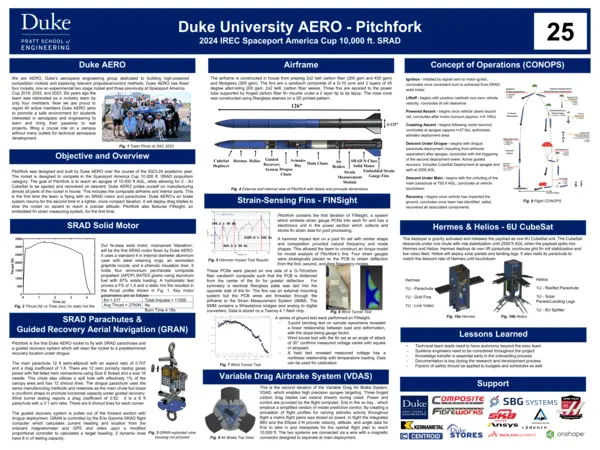
Subsystem lead for FINsight development
Back to portfolio
Rocketry / Embedded Systems
FINsight: Strain-Sensing Fins for Aerodynamic Data Collection
A strain-sensing fin system built for Duke AERO rocket flight analysis using custom PCBs, Wheatstone bridges, ADCs, and embedded data collection.
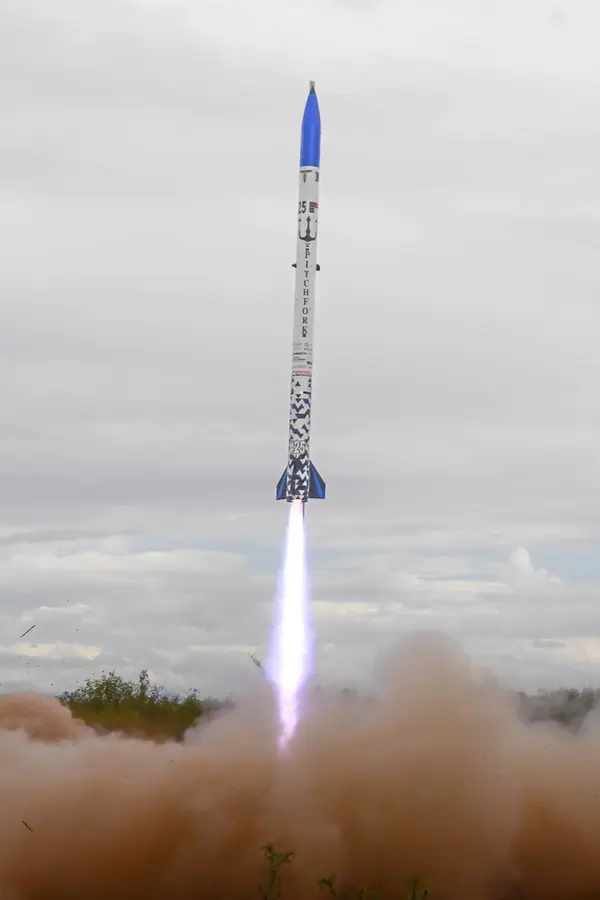
Duke AERO Pitchfork rocket
0.4 mm PCBs, strain gauges, NAU7802 ADCs, Teensy 4.1
Wind tunnel testing up to 35 m/s plus thermal calibration
Highlights
Embedded strain gauges directly into composite rocket fins to measure aerodynamic loading in flight.
Moved sensitive electronics into a 3D-printed Strain Measurement Module to reduce thermal and structural risk near the motor casing.
Connected fin strain data to future design decisions around geometry, mounting, vibration, flutter, and control.
Why it mattered
Problem
Traditional rocket flight data often relies on simulations, onboard cameras, or indirect measurements. Those tools are useful, but they do not directly capture how each fin behaves under real aerodynamic loading. FINsight was created to close that gap by measuring strain at the fin level during flight.
As part of Duke AERO's Pitchfork rocket project, I led development of a system that integrates strain gauges into the fins themselves. The goal was to produce high-resolution data that could reveal how aerodynamic loads, vibration, and temperature changes affect fin behavior during launch.
Electronics and sensing
System Architecture
FINsight uses custom-designed printed circuit boards where copper-trace strain gauges are placed according to modal analysis of the first three fin vibration modes. The strain gauges are arranged as part of a Wheatstone bridge circuit, allowing small fin deformations to be converted into measurable voltage changes.
Those voltage fluctuations are captured by NAU7802 24-bit analog-to-digital converters and processed by a Teensy 4.1 microcontroller. The full electronics stack is housed in a 3D-printed Strain Measurement Module inside the rocket body, which keeps sensitive components away from the high-temperature region near the motor casing.
- Copper-trace gauges were integrated into custom fin PCBs rather than added as external sensors.
- Dual lithium-ion batteries were used to support reliable operation through launch.
- Thermal measurement was included so temperature effects could be separated from structural strain.
Composite fin design
Mechanical Integration
The fins use a sandwich composite structure: a G-10 fiberglass core, the PCB on one side, and carbon fiber reinforcement on the other. This maintained strength while giving FINsight access to the fin strain field. To keep the fin structurally balanced and reduce electrical interference, the PCB was coated with UV-cured solder mask.
Because the PCBs were only 0.4 mm thick, the sensing layer could be added without heavily disturbing the fin's aerodynamic or structural profile. Wiring passed through small slits that were sealed with a carbon-epoxy mix to preserve airframe integrity.
Validation loop
Testing and Results
The system was tested through wind tunnel runs and thermal calibration. In wind tunnel testing, the rocket was exposed to airspeeds up to 35 m/s at high angles of attack to simulate demanding aerodynamic conditions. The strain gauge readings showed a clear relationship between voltage and airspeed, validating that the system was capturing fin loading.
Thermal calibration helped identify how temperature fluctuations could bias the measurements. With the thermocouple integrated into the fin system, FINsight could separate thermal effects from aerodynamic strain more effectively.
What the data enables
Impact
The value of FINsight is not only the measurement system itself, but the design feedback it creates. The data can inform future fin geometry, mounting procedures, mass distribution, and vibration mitigation strategies. It also creates a path toward actively controlled fins that respond to flutter or aerodynamic loading in real time.
As the system matures, future work includes improving calibration, reducing thermal noise, and refining the electronics for better sensitivity and robustness. The long-term goal is to make FINsight a standard part of Duke AERO's design and validation process for future rockets.