Embry-Riddle REU Exploring Aerospace
Back to portfolio
Nanotechnology Research
OECT Research: Aerospace Applications
Research on Organic Electrochemical Transistors for non-invasive glucose detection in aerospace health-monitoring environments.

Organic Electrochemical Transistors for sweat glucose detection
Micrux microfluidic electrochemical sensor with four gold electrodes
PEDOT versus PEDOT/Graphene semiconductor layers
Highlights
Fabricated and tested two OECT variants for non-invasive glucose sensing.
Collected concentration-response data across 0.001 mM to 10 mM glucose solutions.
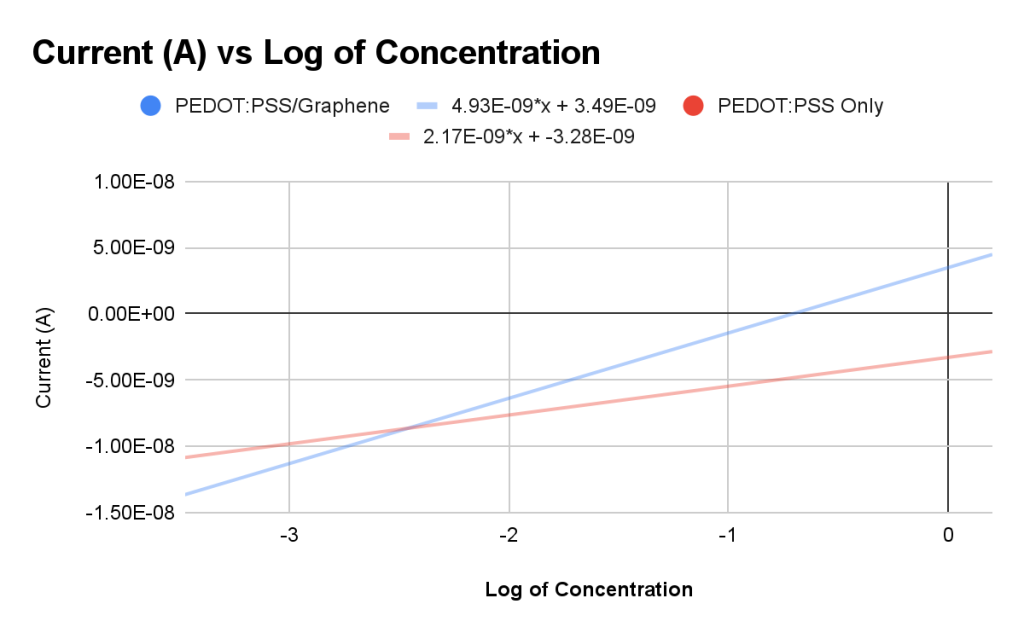
Found that PEDOT/Graphene produced more than double the sensitivity of the standard PEDOT device.
Aerospace health monitoring
Research Context
During the summer, I interned at Embry-Riddle Aeronautical University as part of the REU Exploring Aerospace program. My research focused on Organic Electrochemical Transistors for glucose detection from human sweat, combining electrical engineering, biomedical engineering, chemistry, and aerospace applications.
Pilots and astronauts operate in environments where conventional health-monitoring hardware can be too complex, maintenance-heavy, or slow to recalibrate. The project explored whether OECTs could support simpler real-time monitoring through a non-invasive sweat-based glucose sensor.
Sensor construction
Device Fabrication
The device used a Micrux Microfluidic and Electrochemical Sensor integrated on a single chip with four gold electrodes and a glass substrate. The compact 10 x 6 x 0.75 mm sensor array included a 40 um channel height and 250 um/1 mm channel width for controlled electrochemical measurements.
To fabricate the transistor, the electrodes were masked with Teflon tape so only the interdigitated electrodes remained exposed. A PEDOT:PSS semiconductor solution was deposited between the source and drain electrodes and electrospun to create a thin, uniform layer. A second device used PEDOT mixed with graphene to improve sensitivity and selectivity.
Both device versions were annealed at 130 C to improve adhesion and electronic performance. A glucose oxidase enzyme solution was then drop-cast onto the gate electrode with chitosan to adhere the enzyme to the gold surface.
Measurement workflow
Experimental Method
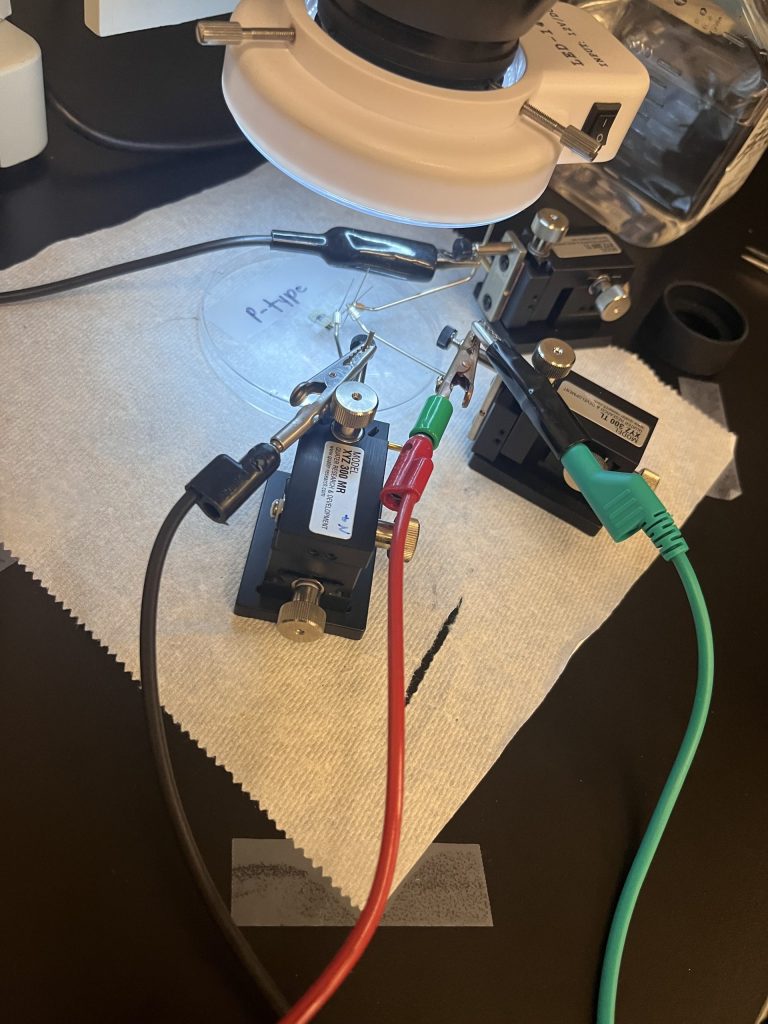
The electrodes were connected to a Keithley 2612B source measure unit using micropositioners, allowing controlled electrical measurements across the device. The first step was measuring current response over a range of gate voltages with phosphate-buffered saline as the electrolyte. This provided the transconductance data needed to choose operating conditions.
Using those conditions, I measured current response at glucose concentrations from 0.001 mM to 10 mM. The sensor output was then compared across the two semiconductor variants to evaluate sensitivity, selectivity, and current-voltage behavior.
What changed with graphene
Results
- PEDOT/Graphene demonstrated sensitivity more than twice that of the standard PEDOT device.
- Both devices showed sigmoid transfer curves, but the graphene-enhanced device produced a stronger current response.
- The sensitivity increase was tied to graphene higher surface area and improved electron mobility.
Research significance
Takeaway
The work showed that OECTs are a promising platform for non-invasive glucose monitoring in challenging aerospace environments. It also demonstrated how material changes at the semiconductor layer can meaningfully affect sensor performance.
Future work could explore additional semiconductor materials, n-type variants, and device-level modifications that make the sensor more stable and practical for biomedical and aerospace use.