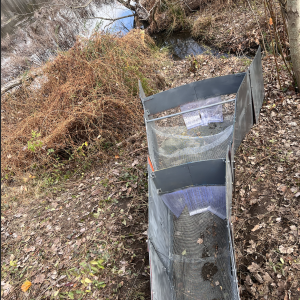
Block trash entering Beaver Marsh Preserve
Back to portfolio
Design / Environmental Engineering
Beaver Marsh Trash Trap
A storm-drain trash trap designed to stop debris from entering Beaver Marsh Preserve while allowing turtles to pass safely.
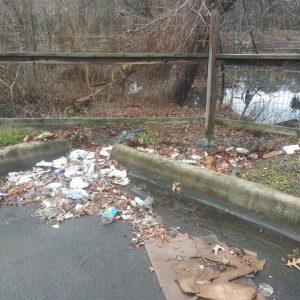
Allow turtles to escape safely through the storm-drain path
Four-person engineering design group
Trap remained in service through heavy storms with no trapped turtles reported
Highlights
Balanced debris collection with wildlife safety, rather than treating the trap as a simple grate.
Used an inclined mesh floor to preserve water flow while catching trash before it entered the preserve.
Added weighted transparent flaps to stop debris while giving turtles an escape route back into the marsh.
Two goals in one system
Design Challenge
For my Engineering and Design course at Duke, I worked with three other engineers to create a trash trap for Beaver Marsh Preserve in Durham, NC. The site needed protection from trash flowing out of a nearby storm drain, but the solution also had to account for turtles that could enter the drain while trying to return to the marsh.
A conventional trap could block debris, but it could also trap wildlife. The project therefore required a design that protected the preserve without creating a new hazard for the animals living around it.
From constraints to mechanism
Concept Development
The team evaluated multiple design directions around water flow, debris capture, turtle movement, cost, and manufacturability. We converged on an inclined mesh system that allows water to pass through the bottom while preventing larger trash from moving into the preserve.
At the end of the trap, we added two weighted transparent flaps. These flaps act as an added debris barrier while still giving turtles a way to push through and return to the marsh. Transparency mattered because the animals needed a visible path rather than a fully opaque obstruction.
Why the geometry works
Prototype Logic
- Inclined mesh reduces the chance that flow pressure pins debris flat against the trap.
- The open mesh surface preserves drainage capacity during rain events.
- Weighted flaps create asymmetric behavior: hard for trash to pass downstream, easier for turtles to push through from the outside path.
- The design keeps maintenance realistic for a preserve setting where access and inspection time are limited.
Field performance
Outcome
The final design was considered successful by the client. It collected trash while maintaining a safe passage route for turtles, and one of the most important outcomes was that no turtles were reported trapped in the device.
The trap also withstood heavy storms and remained installed after almost a year, showing that the structure was durable enough for the water and debris loads at the site. The project reinforced the importance of designing for both technical performance and ecological context.